
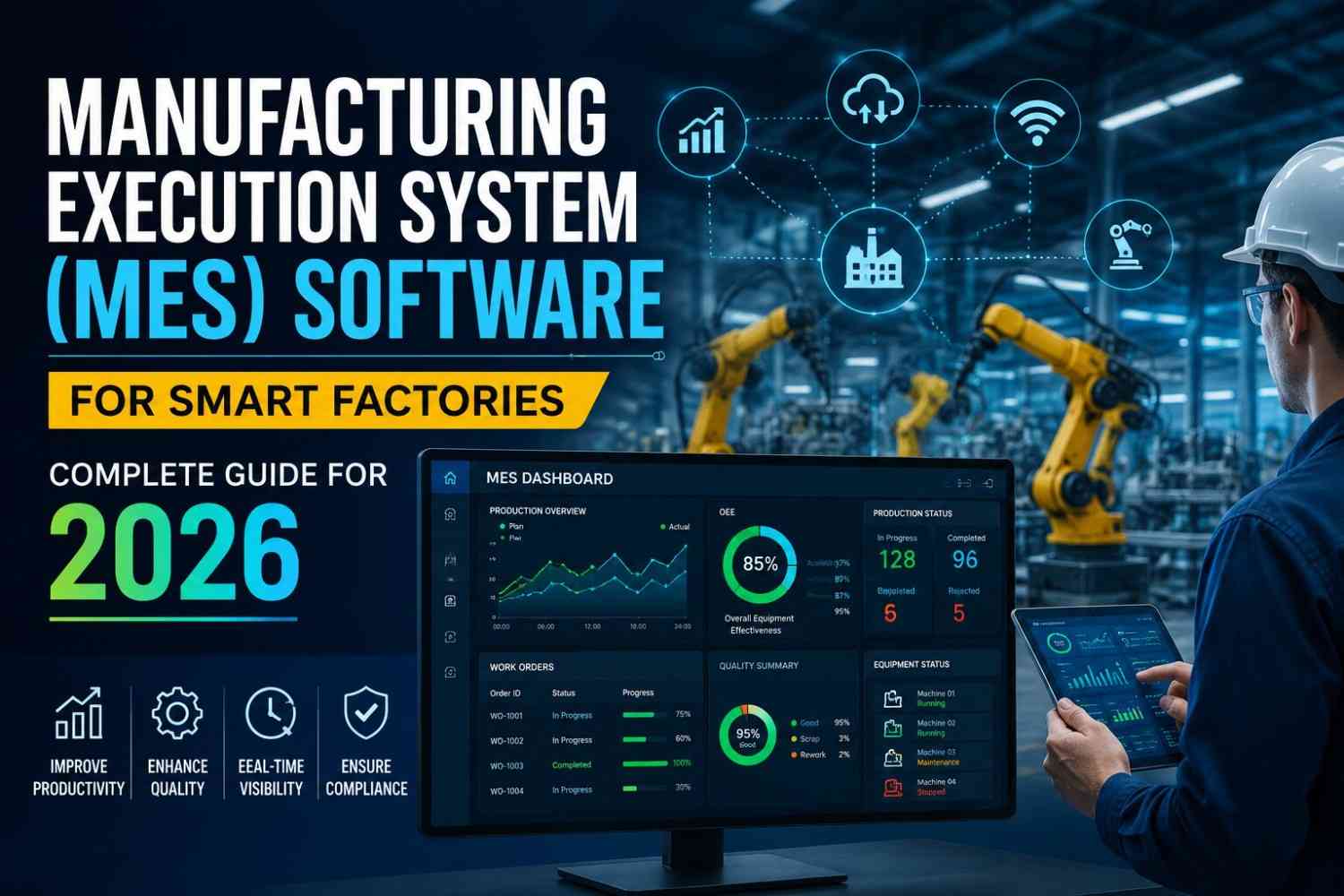
Manufacturing companies are rapidly embracing digital transformation to improve efficiency, reduce production costs, and increase profitability.
In today's competitive industrial environment, manufacturers need more than traditional ERP systems and spreadsheets to manage production operations effectively.
This is where Manufacturing Execution System (MES) Software becomes a critical technology investment.
MES software connects production processes, machines, operators, quality systems, and enterprise software into a unified platform that delivers real-time visibility across manufacturing operations.
What Is Manufacturing Execution System (MES) Software?
Manufacturing Execution System Software is a production management platform that monitors, tracks, documents, and controls manufacturing operations in real time.
MES acts as the bridge between Enterprise Resource Planning (ERP) systems, factory floor equipment, Industrial IoT devices, production teams, and quality management systems. The software collects production data and provides visibility into manufacturing processes from raw materials to finished products.
Why Smart Factories Need MES Software
Modern manufacturers face several challenges: production inefficiencies, equipment downtime, quality issues, labor shortages, supply chain disruptions, and rising operational costs. MES software addresses these challenges by providing real-time manufacturing intelligence and workflow automation.
Key Benefits of MES Software
1. Real-Time Production Monitoring
Manufacturers can monitor production output, machine performance, equipment status, production schedules, and workforce productivity in real time.
2. Improved Production Efficiency
MES software helps organizations eliminate bottlenecks, optimize workflows, improve resource utilization, and reduce waste.
3. Enhanced Quality Management
Supports quality inspections, defect tracking, root cause analysis, and compliance documentation to reduce rework and customer complaints.
4. Better Traceability
Enables organizations to track raw materials, production batches, work orders, and finished products — especially important in regulated industries.
Core Features of MES Software
Production Management
Includes work order management, production scheduling, resource allocation, and capacity planning.
Manufacturing Analytics
Provides insights into throughput rates, downtime metrics, production efficiency, and quality KPIs.
Workflow Automation
Automates production approvals, maintenance requests, quality inspections, and reporting processes.
MES Software and Industrial IoT
Industrial IoT integration enables continuous monitoring of temperature, pressure, energy usage, equipment health, and production output for smarter operational decisions.
MES and Predictive Maintenance
By integrating with Industrial IoT and predictive analytics, MES systems can detect abnormal behavior, predict failures, schedule maintenance proactively, and reduce downtime.
Cloud-Based MES Software
Cloud MES solutions offer scalability, remote accessibility, lower infrastructure costs, and faster deployment — especially beneficial for multi-site operations.
How to Choose the Right MES Software
Manufacturers should evaluate Industrial IoT integration, analytics capabilities, ERP integration, scalability, and security before selecting a platform.
MES Software Trends for 2026
- AI-Powered Manufacturing
- Smart Factory Expansion
- Industrial IoT Adoption
- Advanced Analytics
- Sustainability Tracking
Frequently Asked Questions
What is MES Software?
MES Software is a manufacturing platform that monitors, tracks, and controls production operations in real time.
Why is MES important for smart factories?
MES provides visibility, automation, analytics, and operational control necessary for modern manufacturing environments.
Conclusion
Manufacturing Execution System (MES) Software has become one of the most important technologies for manufacturers pursuing smart factory and digital transformation initiatives.
By combining real-time production monitoring, manufacturing analytics, workflow automation, Industrial IoT integration, predictive maintenance, and ERP connectivity, MES software enables organizations to improve operational efficiency, quality control, and profitability.
As manufacturing continues evolving toward Industry 4.0, MES software will remain a foundational platform for modern industrial operations throughout 2026 and beyond.